Disconnected healthcare systems create unnecessary work. When EHRs don’t connect with billing, scheduling, or other essential platforms, staff often have to enter the same patient information repeatedly, wasting valuable time and increasing the risk of errors. To address these gaps, healthcare organizations are increasingly investing in connected, purpose-built software that brings critical workflows together.
This growing need for connected healthcare technology is reflected in the global healthcare IT market, which is projected to exceed $2,500 billion by 2033.
This guide covers the healthcare software product development process, essential compliance requirements, realistic cost ranges, and practical ways to avoid costly budget overruns.
What is Healthcare Software Product Development?
Healthcare software product development involves designing, building, and maintaining regulated digital systems that handle sensitive patient data and clinical or administrative workflows.
Unlike a one-time software project, a product evolves continuously through new features and improvements based on user feedback.
Your idea could address clinical care, administrative operations, patient engagement, interoperability, remote monitoring, or a combination of these areas. Healthcare software often connects multiple workflows rather than fitting into a single category. The regulated nature of patient data and the need to integrate with existing healthcare systems distinguish healthcare software product development from general software development. These requirements often make custom healthcare software development services a practical choice from the start.
Types of Healthcare Software Products Companies Build
7 product categories cover most of what healthcare organizations build today.
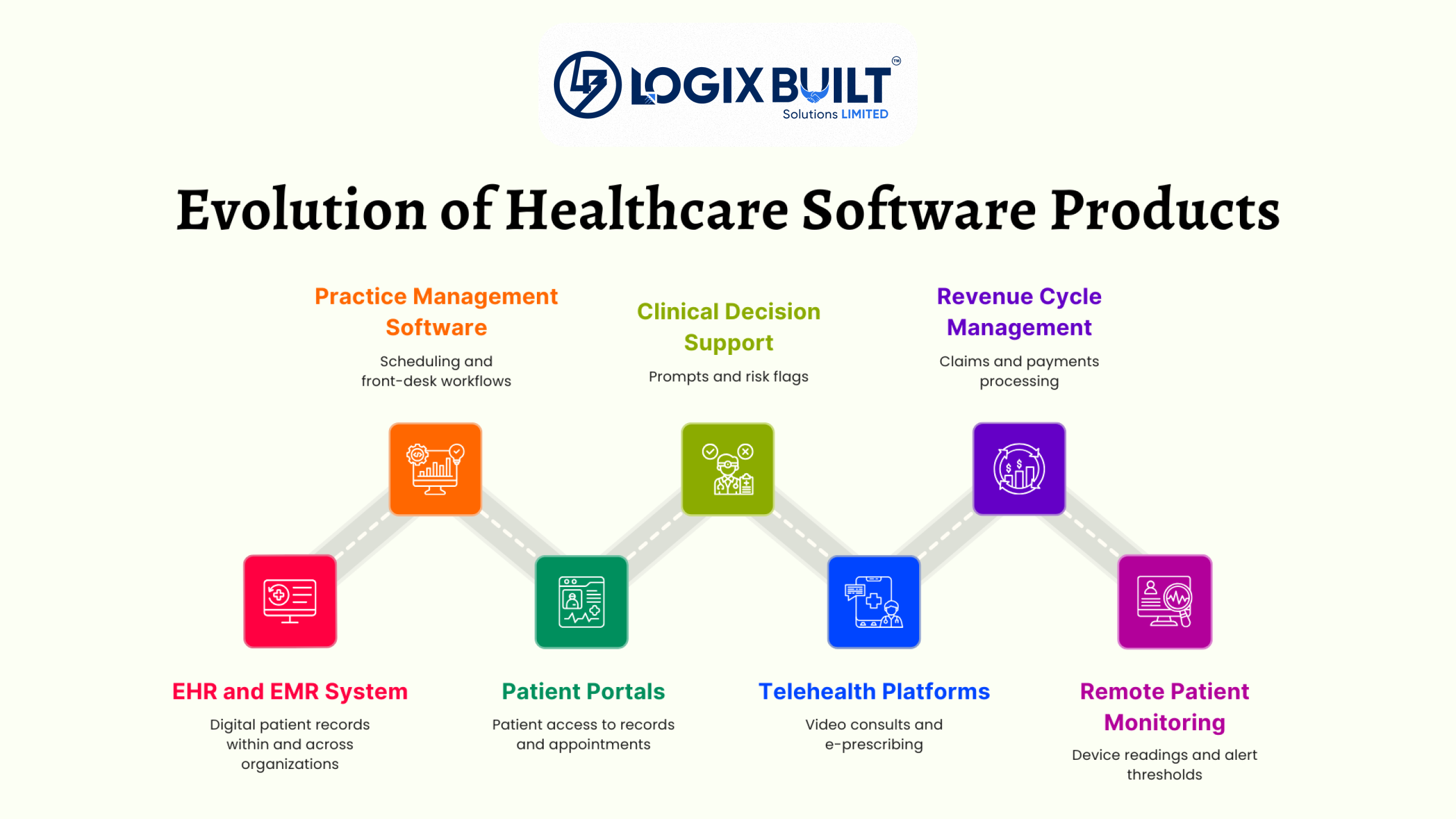
EHR and EMR Systems
An EMR stores patient records within one practice, while an EHR can share records across different healthcare organizations. Both serve as the core patient record and connect with other healthcare tools. An experienced EHR and EMR software development company can help build either system efficiently.
Telehealth and Telemedicine Platforms
Video consultations, messaging, and e-prescribing are at the core of this category. Key challenges include reliable connections on weak networks and secure, end-to-end encryption. These platforms must also sync patient notes with the EHR, making integration essential from day one.
Practice Management Software
This layer manages scheduling, registration, staff rosters, and front-desk operations. The main complexity comes with multi-location practices, where staffing, workflows, and rules can vary by site.
Revenue Cycle Management Software
This covers eligibility checks, coding, claim submission, denial management, and payment posting. Denial management is especially important because rejected claims create significant rework and hidden costs for practices.
Patient Portals
A patient portal gives patients easy access to their records, appointments, results, and messages. Adoption depends on useful, frequently needed features rather than a long list of options. Our patient portal software development services focus on these essentials from the start.
Remote Patient Monitoring Systems
Remote monitoring systems collect data from connected devices between visits and share it with care teams. The key challenges are handling large volumes of data and setting alerts without overwhelming clinicians. When built well, these systems help improve patient outcomes between visits.
Clinical Decision Support Systems
These systems provide guideline-based prompts, drug interaction warnings, and risk alerts to support clinical decisions. Poorly designed alerts can overwhelm clinicians and reduce adoption. FDA applicability depends on the software’s intended use and functionality. Some clinical decision-support features may fall outside medical device regulation, while others may be regulated based on how they are designed and used.
Core Features to Consider For A Healthcare Software Product
Every healthcare product needs a core set of features, while a few advanced capabilities set stronger solutions apart.
Baseline features include role-based access, complete audit logs, encryption for data at rest and in transit, and structured data capture with export support. Audit logging is essential for compliance, and adding it later can require changes across the entire system.
Differentiating features include EHR write-back, real-time dashboards, automated eligibility checks, and configurable workflows. AI-powered tools such as clinical documentation, coding assistance, patient triage, and imaging support can add further value, depending on how AI is used in healthcare.
Step-by-Step Process to Develop Healthcare Software
Building healthcare software solutions follows eight steps. The first three decide what the other five cost.
Discovery And Requirements Gathering
This step maps your current workflow before discussing any solution. The output: a documented workflow, an integration list, and a signed-off problem statement.
Defining End Users And Core Use Cases
A physician, a coordinator, and a patient all need different interfaces on the same data. Naming the primary user first stops you from shipping a product that half-serves everyone.
Solution Architecture Planning
This is where the data model, hosting environment, integrations, and encryption strategy are defined based on compliance requirements, not developer preference.
UX Design And Prototyping
Clinical interfaces get designed around task speed, since any workflow that adds clicks to a consultation gets abandoned fast. Prototypes go in front of real medical professionals before development starts.
MVP Development
The first release carries the smallest set of features that solve the core problem end to end, plus essential integrations, with data security and audit logging built in from the start.
Testing And Validation
Healthcare testing adds layers of general software testing, including integration testing, penetration testing, and clinical validation with daily users. Test data must be de-identified.
Deployment And Launch
Roll out to one site first, with the legacy system running in parallel until data accuracy is confirmed. Staff training and a rollback plan are part of the launch itself.
Post-Launch Maintenance And Support
Ongoing support covers patching, interface updates, regulatory changes, and feedback-driven feature work. Integrations break the moment the other side changes, so monitoring stays continuous.
Compliance Requirements for Healthcare Software Product Development
7 major standards and regulatory frameworks can shape healthcare software development, depending on your product and target market.
HIPAA
HIPAA sets the rules for how protected health information is stored, transmitted, and accessed in the United States. It drives access controls, audit trails, encryption, and business associate agreements with vendors handling patient data.
GDPR
GDPR applies when your product processes the personal data of individuals in the EU/EEA, regardless of where your company is located. It requires a valid legal basis for processing and provides data-subject rights, including access, correction, and erasure, subject to applicable exceptions.
HL7 Standards
HL7 version 2 messaging is still how most hospital systems exchange admissions, orders, and results. Any product integrating with a hospital will likely need to speak it, even alongside FHIR.
FHIR Standards
FHIR is a modern healthcare interoperability standard built around structured resources and APIs. It is increasingly used alongside established standards such as HL7 v2. With 70% of hospitals supporting patient apps that meet FHIR specifications, FHIR adoption is growing. This makes FHIR support an increasingly important consideration when developing healthcare software.
DICOM
DICOM is the standard for exchanging medical imaging data between equipment and health systems. Products handling X-rays, CT scans, or MRIs need DICOM-compatible formats and PACS communication.
SMART On FHIR
SMART on FHIR integrates applications with EHR systems through FHIR APIs, with standardized OAuth 2.0/OpenID authorization and defined app launch workflows.
FDA Regulation Of Software As A Medical Device
Some software functions that provide diagnostic or treatment recommendations may be subject to FDA medical device regulations, depending on their intended use and functionality. These regulatory considerations should be evaluated during the requirements and product design stages.
Challenges the Healthcare Industry Faces in Software Development
Worried About Integration and Adoption?
Legacy systems that don’t connect and tools clinicians end up skipping are what sink most healthcare builds. Get help planning around both from day one.
Healthcare software development comes with several challenges that can affect product performance, adoption, security, and long-term scalability.
Interoperability With Legacy Systems
Most healthcare organizations run several systems never designed to exchange data, so any new product inherits that fragmentation. Mapping integration points during discovery and building against published standards helps reduce complexity. Our healthcare integration services handle this directly, so systems connect smoothly without extra rework.
Cybersecurity And Data Breach Exposure
Patient records carry high resale value, making healthcare systems a standing target. Strong healthcare cybersecurity practices like least-privilege access, encryption, and regular penetration testing help reduce exposure. Breach cost includes regulatory penalties, not just remediation.
Low Clinician Adoption
Healthcare software fails more often on adoption than engineering, since a tool that adds steps to a consultation gets bypassed. Involving medical professionals during design changes the outcome.
Scaling Across Multiple Locations
A system that works for one clinic often breaks across several, since sites differ in staffing, permissions, and local rules. Building configuration by location (rather than hard-coding rules) is what makes expanding to additional locations more predictable and cost-effective.
How Much Does it Cost to Develop Healthcare Software?
Healthcare software development typically costs $15,000 to $200,000+, depending on the product’s complexity, integration depth, regulatory requirements, platform coverage, and legacy data migration. Integration and compliance are two areas that are often underestimated, since they can introduce additional technical, security, and validation requirements.
Ongoing costs are separate: patching, interface maintenance, hosting, and compliance reviews continue throughout the product lifecycle. These expenses vary based on the number of integrations, users, platforms, and regulatory requirements the product needs to support.
| Cost Driver | What Increases It | What Reduces It |
| Number of Integrations | More systems, older APIs, undocumented endpoints | Fewer systems, modern documented APIs |
| Regulatory Scope | Multiple standards | Single jurisdiction, narrow use case |
| Platform Coverage | Web, iOS, and Android built simultaneously | Single platform launch first |
| Legacy Data Migration | Large, messy, or duplicated historical records | Clean, structured source data |
In-House Vs. Outsourced Healthcare Software Development
When it comes to comparing in-house and outsourcing healthcare software development, there is no clear winner. The decision comes down to four things: existing engineering experience, speed to first release, cost structure, and who carries the compliance knowledge.
The case for in-house: full control and direct product knowledge retention. The case for outsourcing: teams already built against HIPAA and HL7, a faster start, and no fixed headcount. Most mid-size healthcare providers run a hybrid model, with an internal product owner directing an external team.
| Criteria | In-House | Outsourced |
| Time to First Release | Slower: Hiring and ramp-up first | Faster: Team already assembled |
| Healthcare Compliance Experience | Builds over time, first project riskiest | Already proven across past builds |
| Cost Structure | Fixed headcount, ongoing salary cost | Variable, scoped to the project |
| Long-Term Knowledge Retention | Stays fully in-house | Requires deliberate documentation |
| Best Suited To | Teams with an existing system or engineering function | Teams without in-house healthcare dev experience |
Best Practices for Developing Healthcare Software
Successful healthcare software development requires more than standard engineering practices. Teams need to account for compliance, clinical workflows, interoperability, data security, and long-term product ownership from the start.
- Design compliance into the architecture: Address compliance requirements during architecture planning rather than treating them as an audit-stage task.
- Validate workflows with medical professionals: Test workflows with the clinicians and other healthcare professionals who will actually use the product, not only the stakeholders who commissioned it.
- Build against published standards: Use established interoperability standards where applicable to make integrations more reliable and easier to maintain.
- Protect test data: Use de-identified or synthetic data for testing whenever possible, with appropriate safeguards for any sensitive data that must be used.
- Define data ownership and exit terms: Agree on who owns the data and how it can be transferred before development starts. This makes it easier to migrate records if the relationship with a vendor or development partner ends.
- Evaluate every feature against a real need: Ask whether each feature solves a genuine user or business problem rather than simply adding another item to the product roadmap.
Build Your Custom Healthcare Software With Logix Built
Your product type decides the integration load, compliance shapes the architecture, and cost tracks integration depth more than feature count.
Logix Built develops clinic management systems, EHR platforms, billing automation, and patient-facing tools for healthcare providers in the US. With 150+ brands and over 2000 projects across regulated industries, it has built a track record most medical software teams take years to achieve.
Ready to build something that handles compliance from the ground up? Talk to our healthcare software development services team to discuss your requirements and scope.
FAQs on Healthcare Software Product Development
Here are quick answers to the questions healthcare founders and IT leaders ask most before starting a build.